
SUCROSE BRIX BEFORE FERMENTATION
Read the sucrose
scale.
Stop at the liquid.
Brix Meter is a UK editorial reference for sucrose Brix on juice, soft drinks, unfermented apple or grape juice, and original wort. Each page keeps the published range, the liquid and the temperature window beside the explanation. Honey moisture, coffee solids and urea stay on other scales.
SUCROSE BRIX / UNFERMENTED LIQUIDS / NAMED SOURCES
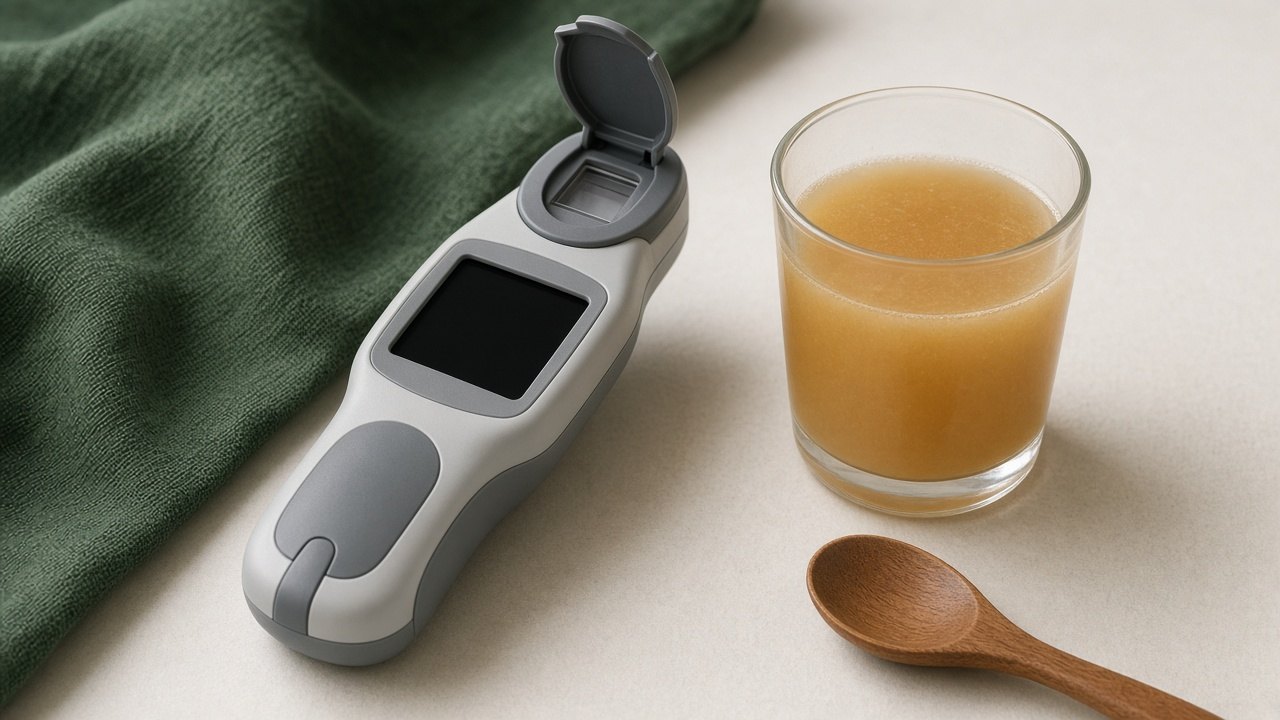
START WITH THE LIQUID
What do you need to establish?
Establish the liquid, the published scale and the decision the number needs to support. Unfermented juice and original wort are the liquids this reference discusses. Fermentation, honey moisture, coffee solids and urea each need a different page family, and those families are not published here as interchangeable conversions.
What does this Brix number report?
A sucrose Brix indication is soluble solids on a sucrose scale. Acids, salts and other dissolved material in juice also move the number. The pages keep that definition next to the reading so it is not treated as grams of sucrose, honey moisture, coffee solids or urea. Record the liquid and the published scale before comparing two meters.
Find your starting point ↗02Does this meter cover the liquid?
Three associated sucrose listings stop at 53.0%, 55% and 0–85% Brix. Overlap below 53% is a range fact. It is not proof that the three displays agree on the same sucrose standard, and it is not a jam-setting method. Traditional high-sugar jam may leave the two narrower meters before any setting point discussed in cookery texts.
Find your starting point ↗03Has fermentation already started?
Alcohol changes the refractive reading while a hydrometer still reports density. Terrill and Novotny are two named beer formulas with published bounds. This site does not host a calculator and does not apply those formulas to cider, honey or urea. If you need finishing gravity, use a hydrometer or the named external method with its own limits.
Find your starting point ↗WHEN ALCOHOL IS PRESENT
Why does a refractometer
disagree with a hydrometer?
Alcohol changes the refractive reading while a hydrometer still reports density. Sean Terrill fitted beer wort after dropping very low-attenuation samples. Brewer’s Friend uses Petr Novotny’s 2017 formula. Those are two external beer methods. This site names them and stops. It does not host a calculator and it does not apply either formula to cider or honey.
Read the fermentation boundary ↗Name the liquidUnfermented juice or wort, not a mixed scale.
Name the formulaTerrill and Novotny are not the same fit.
Keep the boundsA calculator without bounds becomes a general conversion.
MEASUREMENT EXPLAINED
What can a sucrose Brix page establish?
Each guide answers one question about the sucrose scale: what the number reports, where three meters stop, what compensation covers, how unfermented juice is read, and what changes after fermentation. Sources and limits stay on the page. A specification on a shop listing is not a result measured by this editorial team.
What does a sucrose Brix reading report?
A digital sucrose meter reports soluble solids as if the sample were sucrose in water. Acids, salts and other dissolved material in juice also bend light, so the indication is not grams of sucrose per 100 g. Keep the scale, the liquid and the temperature with the number. This page does not convert that reading into honey moisture, coffee solids or urea.
Read the reference GuidesWhat does automatic temperature compensation cover?
Automatic temperature compensation is a stated operating window, not permission to ignore sample temperature. The HighPrecis listing writes 10–40°C. ATAGO’s PAL-1 page writes 10–100°C and still sells a cooling cover for hot samples. Distilled water is the zero check on these digital sucrose meters. Olive oil, liquid paraffin and a 78.8°Bx fluid belong to honey-moisture practice and are not a procedure on this site.
Read the reference GuidesHow is unfermented juice or wort read on a sucrose meter?
A hand-held sucrose meter can read a drop of unfermented apple juice, grape must or wort. Andrew Lea uses that drop for summer sugar in cider fruit, then changes to a hydrometer when specific gravity is the decision. Fifteen percent sugar and a gravity near 1.070 are his background figures, not a reading from our meters. After fermentation starts, this page stops.
Read the referenceTHREE SUCROSE LISTINGS
What is written for the
0–55%, PAL-1 and MA871?
The HighPrecis listing writes 0–55% Brix, ±0.2% and ATC 10–40°C. The PAL-1 listing writes 0.0–53.0% Brix and ±0.2%. The Milwaukee homepage writes 0–85% Brix and ATC. Accuracy is not restated from the damaged homepage sentence. These profiles are documentation reviews, not comparisons we have run.
Read the instrument profiles →0–55% listingJuice and soft-drink sucrose BrixStop at 55% · ATC 10–40°C
PAL-10.0–53.0% Brix · ATAGO also names low-sugar jamCooling cover sold for hot samples
MA871 homepage0–85% Brix · ATC mentionedAccuracy not restated
SOURCES, WITH THEIR LIMITS
What supports this reference?
The pages use UK retail listings, ATAGO’s PAL-1 text, Andrew Lea’s cider notes, and two named beer formulas. Each guide keeps the author’s bounds beside the claim. No sucrose-standard series from this team is published. Related shops that sell honey, coffee or DEF meters are named only on the disclosure page.
- ATAGO USA: PAL-1 product page ↗
Manufacturer page. Brix is defined on sucrose in water. Additional solutes change the indication. Checked 23 September 2026.
- Andrew Lea: cider making, part 3 ↗
UK cider chemist. Hand-held refractometer on unfermented juice; hydrometer after pressing when specific gravity is required.
- Sean Terrill: refractometer FG results ↗
Eight brewer–instrument sets. Beers below 50% RDF were removed. Sixty-eight independent triplets remain. Beer wort only.