
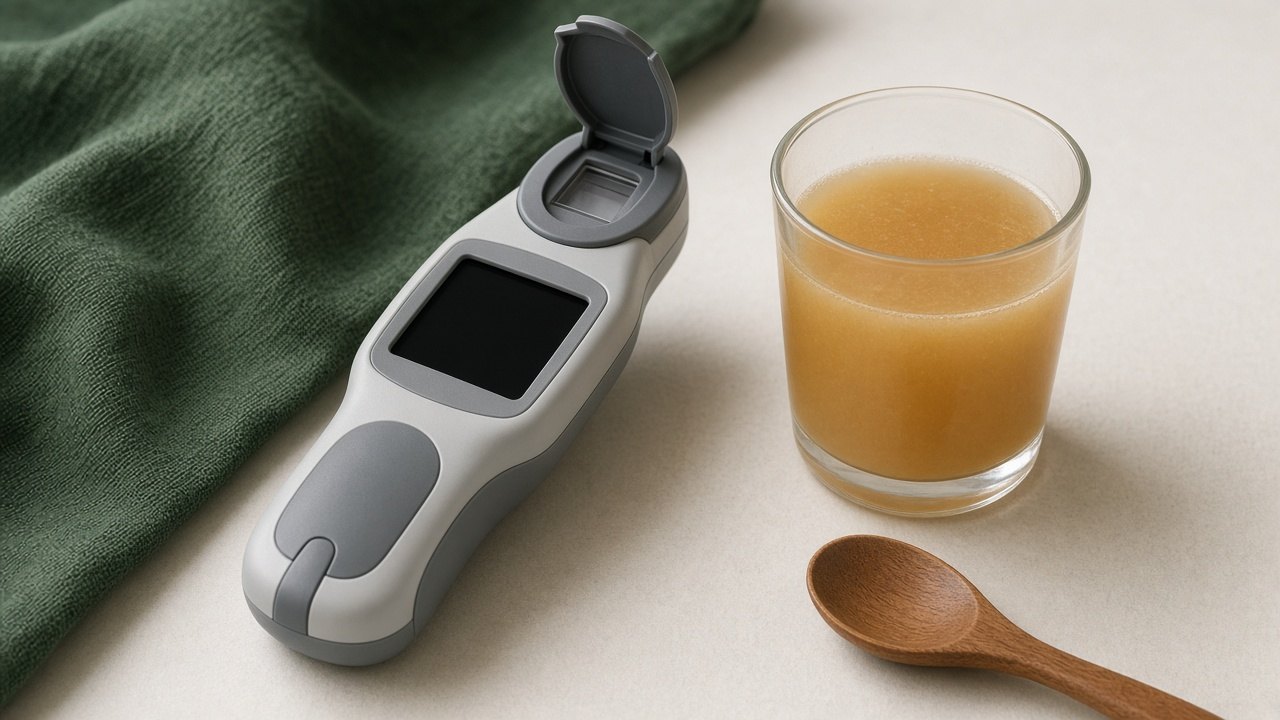
A hand-held sucrose meter can read a drop of unfermented apple juice, grape must or wort. Andrew Lea uses that drop for summer sugar in cider fruit, then changes to a hydrometer when specific gravity is the decision. Fifteen percent sugar and a gravity near 1.070 are his background figures, not a reading from our meters. After fermentation starts, this page stops.
Source-based explanationWhen is a drop of juice enough?
Unfermented juice and unfermented wort are the liquids this site is willing to discuss on a sucrose scale. A drop is enough when the question is soluble solids before alcohol is present and the indication sits inside the meter’s published range. Stir or press so the drop represents the batch, then record the fruit or wort identity. A drop does not become a statutory sugar declaration, and it does not become a hydrometer gravity unless you also take that measurement.
When should a hydrometer take over?
Andrew Lea writes that after pressing he uses a hydrometer because the instrument is inexpensive and because specific gravity is then the quantity he needs. He gives a chaptalisation note only against gravity: if juice is below 1.045, 12–15 g of sugar per litre raises gravity by about 0.005, and the gravity is measured again. That is a hydrometer procedure. This site does not turn his grams-per-litre note into a Brix increment on the HighPrecis, PAL-1 or MA871 listings.
What do Andrew Lea’s summer figures establish?
Lea writes that a good summer may reach about 15% sugar, corresponding roughly to specific gravity 1.070 and a potential alcohol near 8.5%. A cool wet summer may stay below 10%, near 1.045 and about 6%. Those pairings are his background for English cider fruit, not a certificate for an orchard and not a test that three digital meters agree. Fifteen percent sits inside all three published ranges.
How should original wort be treated on a sucrose meter?
Home-brewing meters are often sucrose-calibrated even when the liquid is wort. Brewer’s Friend asks for at least thirty unfermented wort samples before a wort correction factor is claimed, and it says alcohol throws the reading off. An example on that page is 19 divided by 1.04, giving 18.26, for unfermented wort only. That factor is an external software default, not a factor measured on the three listed meters. Do not carry it onto cider, honey or any fermented sample.
Which sources support this reference, and what are their limits?
These sources support the terminology, declared ranges and attributed observations discussed here. Retailer and manufacturer sentences are not measurements by Brix Meter. Another author’s beer or cider figures stay inside the liquid they measured. The pages were checked on .
- Andrew Lea: cider making, part 3 ↗
UK cider chemist. Hand-held refractometer on unfermented juice; hydrometer after pressing when specific gravity is required.
- Andrew Lea: Craft Cider Making, site note ↗
Author note: retired food biochemist, Long Ashton cider group, IFST fellow. Not an instrument shop.
- Brewer’s Friend: wort correction factor ↗
Software help page. At least thirty unfermented wort samples are requested. Alcohol is said to throw the reading off.
What should stay with the reading?
A useful Brix record keeps the liquid, the published scale, the sample temperature, the instrument and the original indication together. Use the blank record if you need a field list. See how we assess evidence and the commercial relationship when judging a published conclusion.