
Once alcohol is present, a sucrose Brix indication and a hydrometer gravity can disagree on the same beer. Sean Terrill fitted beer wort after discarding very low-attenuation samples. Brewer’s Friend uses Petr Novotny’s 2017 formula instead. Those are two external beer methods with stated bounds. This site does not host a calculator and does not apply either formula to cider, honey or urea.
Source-based explanationWhy can a refractometer and a hydrometer disagree after fermentation?
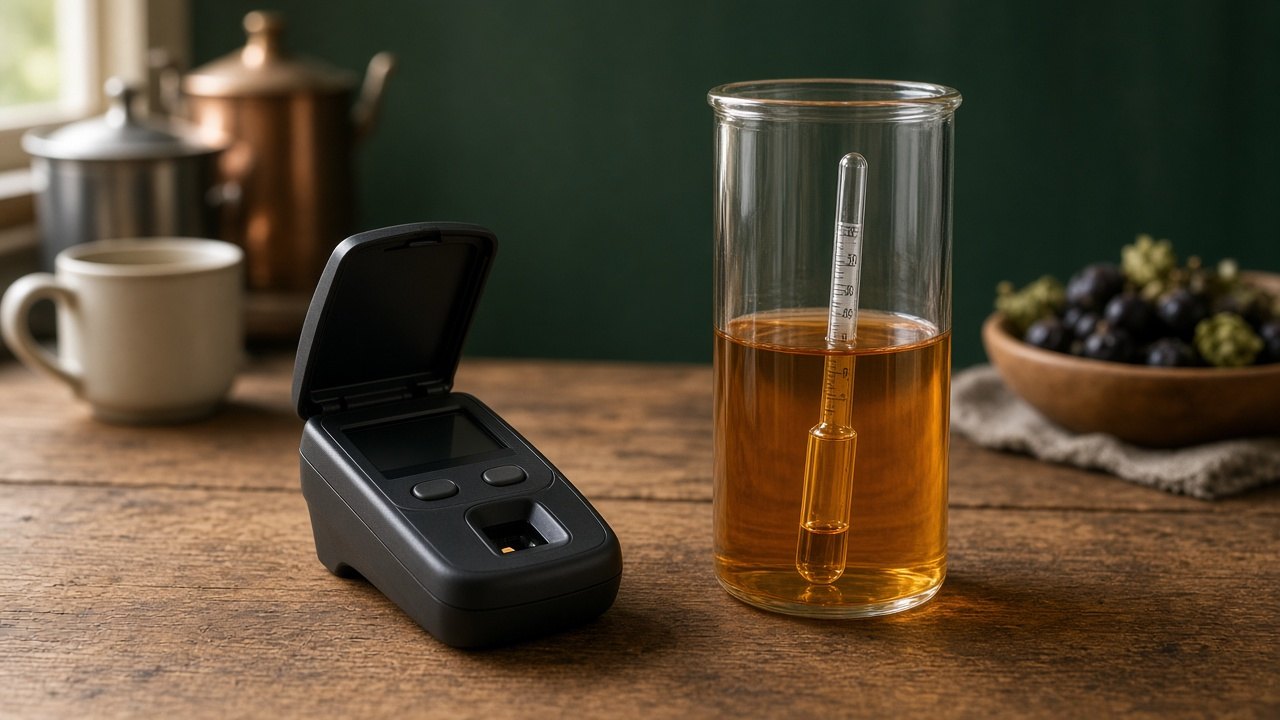
Alcohol has a different refractive effect from the sugars that remain. A sucrose scale therefore continues to report a number that is no longer a simple original-gravity analogue. Marshall Schott recorded one beer at hydrometer 1.012 and refractometer about 1.024, or 6.1°Bx, then entered the figures in Terrill’s calculator. That is one inexpensive dual-scale meter and one batch. It shows the disagreement; it does not certify any of the three meters listed on this site.
Are Terrill and Novotny the same formula?
They are not. Terrill’s 2011 note starts from eight brewer–instrument sets, removes beers he defines as below 50% RDF, and fits a simplified cubic to sixty-eight independent triplets. His calculator defaults to a wort correction factor of 1.040 because a sucrose-calibrated meter is reading wort. Brewer’s Friend states that its fermentation correction uses Petr Novotny in Zymurgy July/August 2017. Naming both formulas is the point. Averaging them, or hiding the name, would erase the boundary each author wrote.
Can one alcohol-correction formula be used for beer, cider and wine?
Terrill’s published fit is beer wort inside the original gravity, finishing gravity and attenuation bounds he kept after dropping low-RDF beers. Novotny’s article, as cited by Brewer’s Friend, is a brewing-magazine fermentation monitor, not a cider or wine method on this page. Andrew Lea does not offer an alcohol-correction polynomial for cider. Applying either beer formula to English cider, to honey or to a urea solution would be a change of liquid. This site does not make that change.
Why does this site not publish a calculator?
A calculator without sample bounds becomes a general conversion, which is the error this reference exists to stop. Until original Brix, apparent finishing Brix and hydrometer finishing gravity exist on a named meter, there is nothing of ours to compute. If such rows are published, they belong on a fermentation page. Use the named external calculators with their own limits, or use a hydrometer.
Which sources support this reference, and what are their limits?
These sources support the terminology, declared ranges and attributed observations discussed here. Retailer and manufacturer sentences are not measurements by Brix Meter. Another author’s beer or cider figures stay inside the liquid they measured. The pages were checked on .
- Sean Terrill: refractometer calculator ↗
Personal brewing notes. Default wort correction factor 1.040. Not a laboratory method and not a UK cider data set.
- Sean Terrill: refractometer FG results ↗
Eight brewer–instrument sets. Beers below 50% RDF were removed. Sixty-eight independent triplets remain. Beer wort only.
- Brewer’s Friend: refractometer calculator ↗
Uses Petr Novotny, Zymurgy July/August 2017, not Terrill’s cubic. Product feature with a paid membership.
- Brewer’s Friend: wort correction factor ↗
Software help page. At least thirty unfermented wort samples are requested. Alcohol is said to throw the reading off.
- Brülosophy: are refractometers worth it? ↗
One beer, one inexpensive dual-scale optical meter. Hydrometer 1.012 versus about 1.024 (6.1°Bx). Affiliate links on the site.
What should stay with the reading?
A useful Brix record keeps the liquid, the published scale, the sample temperature, the instrument and the original indication together. Use the blank record if you need a field list. See how we assess evidence and the commercial relationship when judging a published conclusion.